FIXED INSTALLATION · KNOWN CHEMISTRY
Solar has been flat for fifty years. The Holme Panel adds the third dimension.
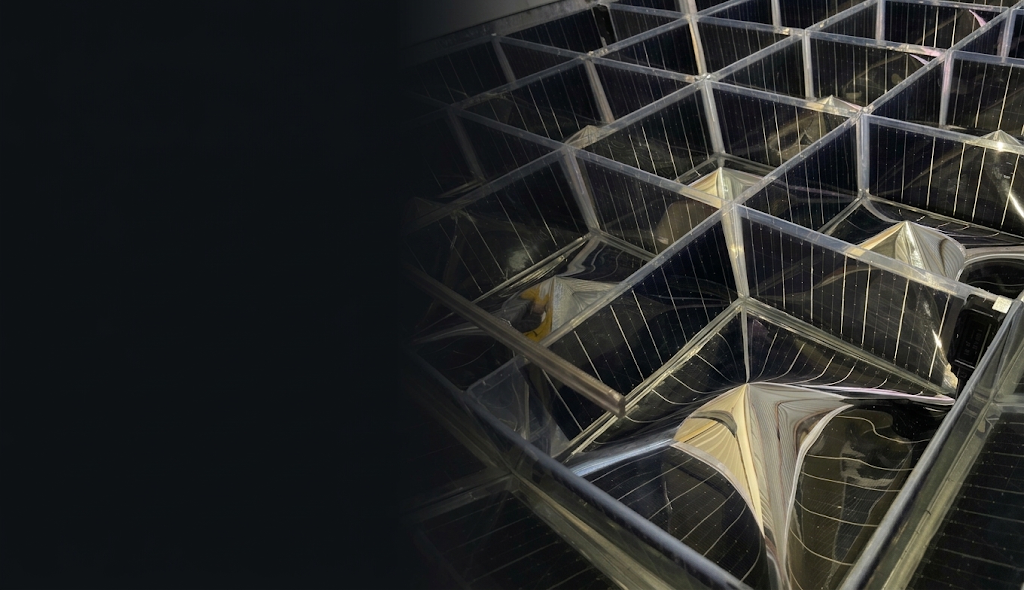
Standard bifacial HJT cells, stood vertically inside a sealed light-trapping cavity. One module that is at once a structural truss and a 3D energy trap — delivering roughly five times the annual energy from the same land.
MPP
~1.3×
Specific yield
~1.5×
Ground coverage ratio
~85% vs ~33%
Annual energy, same land
≈5×
THE 2D CEILING
Cells have improved every year. The module around them has not.
01 · Area (CTMr)
One square metre holds one square metre of cell
A flat module can never carry more active silicon than its own footprint — minus frame and spacing losses.
02 · Angle (AOI sensitivity)
Short productive window around noon
Morning and evening sun is largely lost — unless you add trackers and their moving parts.
03 · Land (GCR)
Two-thirds of the site is empty
Tilted rows cast shadows, so they must be spaced apart. A typical utility field covers about a third of its land with panels.
THE ARCHITECTURE
Same cells. New geometry.
The Holme Panel does not depend on a new cell chemistry. It re-engineers the module so that standard, bankable HJT cells collect more energy, for more hours, on less land.
Vertical, bifacial, both faces working simultaneously in direction of sun
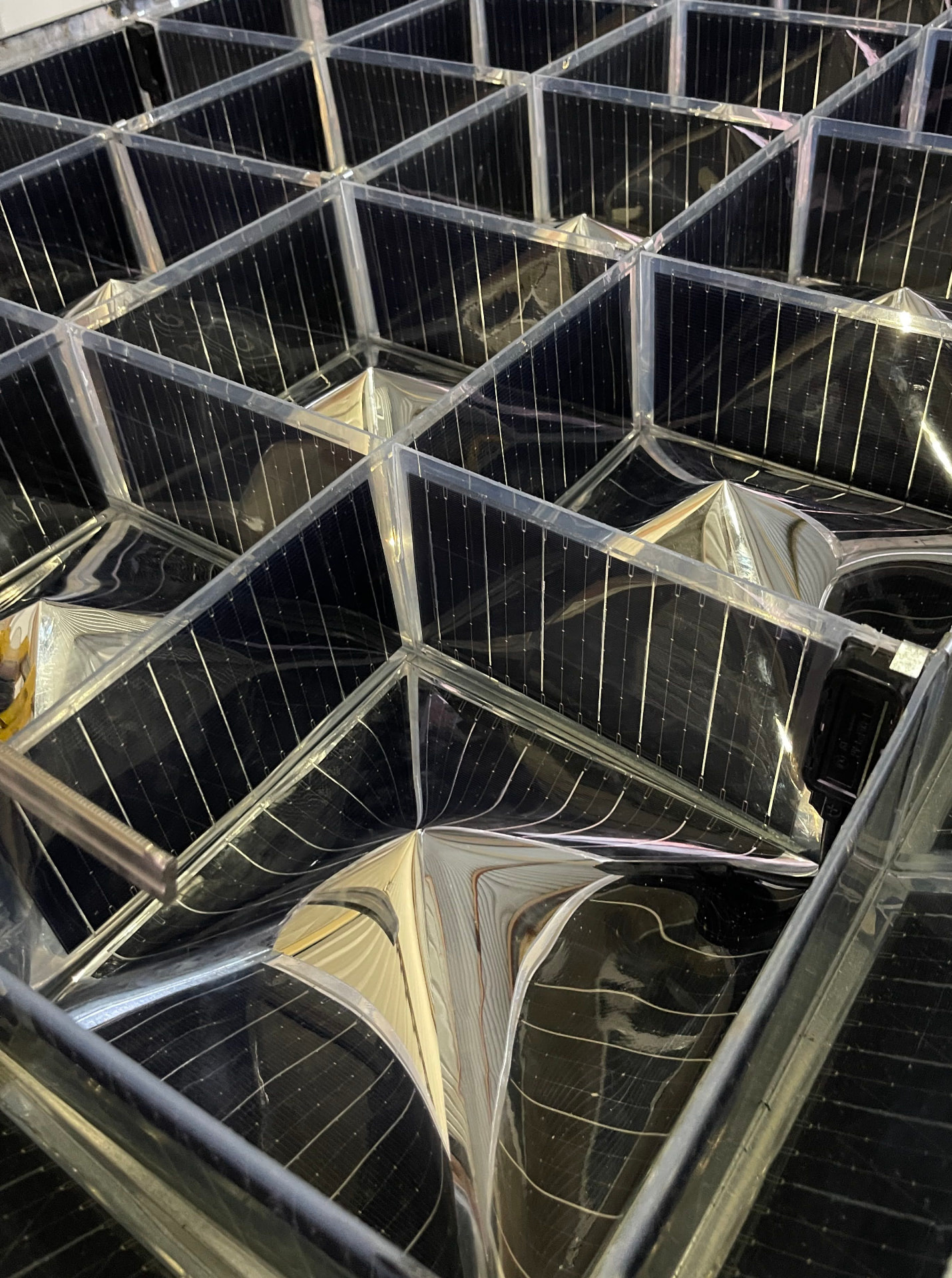
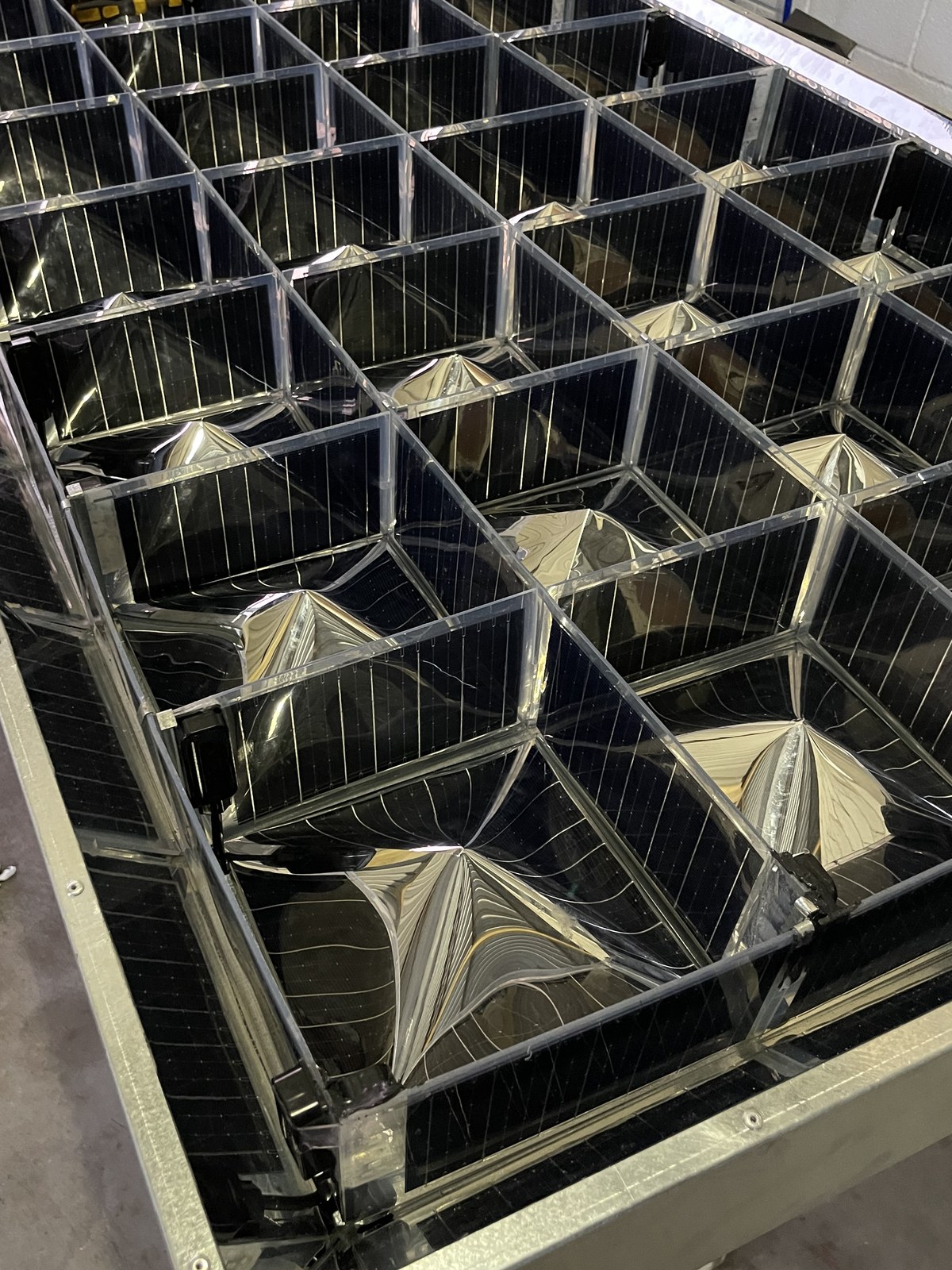
Cells stand upright in a grid. Front and back faces harvest simultaneously — more than two square metres of active cell surface for every square metre of module.
A 3D energy trap
Super-efficient reflectors in each well scatter light onto both cell faces. Front glass admits light from outside and holds it inside until it reaches a cell. Diffuse, not specular — no concentrated hotspots.
Angle becomes an advantage
Because the cells face every direction in the cavity, sensitivity to angle of incidence is a property of the geometry — and the geometry favours oblique sun.
Hermetically sealed
Inside of panel is a sealed cavity, similar to a double-pane window, effectively protecting all parts from dust, humidity and more.
PERFORMANCE, BY COMPOUNDING EFFECT
Three gains that compound.
Each metric is measured differently, and each is independent of the others. That is why they compound.
×1.30
Peak power (MPP)
W per m² of module at peak, above the cells' own nameplate — from more cell area per footprint and light delivered to both faces.
×1.50
Specific yield (SY)
kWh per kWp per year at a given location. A wider production day with two peaks instead of one.
×2.55
Ground coverage (GCR)
Panel area as a share of land. Installed near-flat at ~85% GCR, against ~33% for tilted rows.
≈5.0×
Annual energy per hectare
1.30 × 1.50 × 2.55. The same land, the same sun, roughly five times the energy.
Two peaks. Both higher than noon.
A conventional module peaks once, at solar noon. The Holme Panel produces two peaks — mid-morning and mid-afternoon — each about 30% above a conventional peak. Its midday dip sits at the level of the conventional peak, so nothing is traded away.
That shape lands energy closer to morning and evening demand, and pairs naturally with storage that dispatches into price peaks.
STRUCTURE & LIFETIME
The module is the structure.
Front glass, vertical laminated cells and backplate are bonded into a true engineering truss. Load paths run through the glass, not the wafers — removing the flexing that drives microcracking in flat laminates.
Longer life expectancy
Design-life expectation, from eliminating cell flexing and microcracks.
Hail
Low angle sensitivity allows steep installation in hail-prone regions without giving up output.
Object shading
Object-shading resilience: recessed cells sit behind the glass, so light reaches them around small objects on the surface.
O&M
O&M scales with land and glass, not watts. Per kWp: roughly two-thirds less land to maintain and less glass to clean.
DOWNSTREAM EFFECTS
A module change that reaches every link in the chain.
Module manufacturers
- Uses standard HJT cells and established glass and edge-seal processes
- Integrates into an existing line with an added assembly step
- A differentiated, higher-value product without a new cell fab
- Every future cell gain is amplified by the same architecture
Developers & IPPs
- Several times more energy per hectare of leased or permitted land
- Tracker-like daily profile with no motors, gears or moving parts
- Production shifted toward morning and evening value
- Viable sites where land, not sunlight, is the constraint
Asset owners
- Repower aging farms on the land, permit and grid connection you already hold
- 4–7× energy from the same site, with storage to use full export capacity
- A long-life asset: 40-year design horizon
EPCs & installers
- Near-flat, dense layouts — fewer rows, no inter-row shading studies
- Fixed mounting; no tracker commissioning or maintenance
- Flexible tilt for hail, snow and rooftop constraints
Data centres & large offtakers
- More clean energy within an existing footprint or nearby legacy farm
- Repowering as a fast route to energy-offset commitments
- A twin-peak profile that firms more easily with batteries
Investors
- An architecture licence that rides on, rather than competes with, cell progress
- Value per square metre of land, not price per watt, as the key metric
- Cases built without subsidies or tax credits
THE REPOWERING OPPORTUNITY
The fastest new terawatt-hours are on land that is already solar.
Europe and the USA each hold 100s of GW of first-generation solar farms. Their land is permitted, their grid connections are built. Repowered with Holme Panels and paired with storage, the same sites can add 1000s of TWh of additional energy per year.
Market and uplift figures are modelled estimates; site results depend on interconnection headroom, setbacks and storage sizing.
Modelled case — 2017-vintage 1 MW farm, 5 acres
| Today | Repowered | |
|---|---|---|
| Capacity | 1.0 MW | ~6 MW |
| Ground coverage | 33% | ~85% |
| Annual energy | 1.6 GWh | ~10 GWh |
| Land, permit, grid | existing | upgrade dep. local reg. |
FAQ
GO DEEPER
Further insights
Terms used
- MPP
- CTMr
- SY
- AOI
- GCR
- HJT
- Heterojunction (cell technology)
- kWp / Wp
- kilowatt-peak / watt-peak
- O&M
- Operations and maintenance
- LCOE
- Levelised cost of energy
- IPP
- Independent power producer
- EPC
- Engineering, procurement and construction
- NDA
- Non-disclosure agreement
Request a technical briefing.
Full specifications, test data and design-for-manufacture details are shared under mutual NDA. Tell us who you are and we'll route you to the right conversation.
Or write directly: info@holmepanel.com